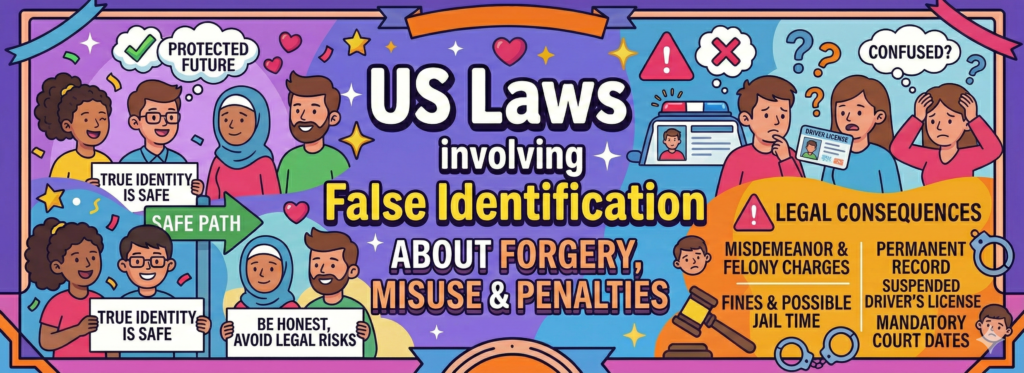
US Laws | Identification
🎯 Content Objective
You will be able to explain what a false ID is, why using or lending one is illegal in the United States, and what serious legal and school consequences can follow.
🗣️ Language Objective
You will be able to identify and use key vocabulary words — including false ID, identity, fraud, consequences, and mandatory reporter — to explain ideas from the text.
📋 Assignment Directions
Read the scenario below carefully. Then read all five sections of this lesson. Words in parentheses ( ) are definitions — they help you understand important vocabulary. After each section, answer the comprehension check questions. Your answers must come from the text. Do not guess.
⚠️ Key Law
In Utah and across the United States, using a false ID or someone else’s ID is a crime. It does not matter if you used it “just once.” It does not matter if nothing bad happened. The act of using the wrong ID is itself a legal violation.
🎬 Scenario: “It Was Just to Get In”
You are 17. Your older cousin is 21. There is a concert on Friday night — 21 and over. Your cousin says: “Just use my ID. You look enough like me. Nobody checks that closely.”
You take it. It feels small. It feels harmless. You get in. Nothing happens that night.
But two weeks later, your cousin’s ID is flagged (identified as suspicious) at a different location. An investigation begins. Security footage shows you using the ID at the concert venue. Your name is connected to the incident.
An officer contacts your school. Your school administrator is notified. Your parents receive a call. You are facing a citation for 🔴 identity fraud (using someone else’s identifying information to deceive others), and your cousin is facing charges for providing a false ID to a minor.
You keep thinking: nothing bad happened that night. Nobody got hurt.
But the officer explains it differently: “Something did happen. You used an ID that was not yours to gain access you were not legally allowed to have. That is a crime. The fact that it worked does not make it legal.”
💬 You thought it was harmless. The law says otherwise. Read on.
📖 What is an ID, and why does it matter under the law?
In the United States, an 🔴 ID (a document used to show who you are, including your name, age, and identity) is a legal (allowed by law) document. IDs include a school ID, a state-issued ID card, a driver license (a card that shows you are legally allowed to drive), or a passport. These documents exist (are real and active) to confirm (make sure) that a person is who they say they are.
The law (the official rules that people must follow) requires (demands) that you use only your own ID. A 🔴 false ID (an ID that is fake or not real — made to look like a real ID but is not) and a 🔴 borrowed ID (using someone else’s real ID as if it were yours) are both 🔴 illegal (not allowed by law) in all 50 states, including Utah. It does not matter if the ID looks real. It does not matter if you only used it one time. The same (not different) law applies every time.
Many teens think (believe) that using a borrowed ID “just once” is not a serious problem. This is wrong. The law does not look at how many times you did something. It looks at whether you did it at all. Right (correct) now, knowing this rule protects you before you are ever in that situation.
💬 Comprehension Check — Section 1
- According to this section, what is a false ID?
- According to the text, does the law care if you only used a borrowed ID one time? Explain using a detail from the text.
- What does the word illegal mean as used in this section?
📖 Why is using the wrong ID treated as a serious crime?
Using a false or borrowed ID is not just a school rule violation — it is a crime under Utah state law and federal (national) law. When you use someone else’s ID, you are committing 🔴 fraud (the act of deceiving — tricking — someone in order to gain something you are not legally allowed to have). Fraud is taken seriously by courts, employers, and schools across the United States.
When someone is caught using the wrong ID, 🔴 consequences (results or outcomes — often negative — that come from an action) begin quickly. Police (law officers) may become involved. A 🔴 citation (an official written notice that you broke a law and must appear in court or pay a fine) may be issued. If the case goes to 🔴 court (a legal place where a judge makes decisions), a judge can order fines (money paid as a penalty), community service, or other penalties. These consequences do not disappear simply because you return the ID or delete messages afterward. The law looks at the action — not what happened after.
There is another important fact: if you lend your ID to someone else, you can also be charged with a crime. Helping a friend by giving them your ID is not a small favor. It is a legal 🔴 offense (a legal violation — one time you broke the law) that can result in consequences for both people. The law (the rules people must follow) does not make exceptions (special situations where the rule is different) for good intentions.
💬 Comprehension Check — Section 2
- What does fraud mean as used in this section?
- According to the text, does returning the ID or deleting messages erase the legal problem? Use a detail from the text to explain.
- According to this section, can the person who lends their ID also get in trouble? Explain.
📖 How can using a false ID affect your school record and your future?
The consequences of using a false or borrowed ID do not stay outside of school. Under Utah law and federal education guidelines, school administrators (people who manage and run the school) and certain teachers are 🔴 mandatory reporters (people who are required by law to report knowledge of illegal activity involving a minor). If your school learns that you used a false or borrowed ID — from police, from a report, or from another student — the school is required to act.
This can mean serious 🔴 school discipline (punishment given by the school for breaking a rule or law), including suspension (being temporarily removed from school) or removal from activities like sports, clubs, or student leadership. It can also mean a note in your 🔴 academic record (an official document that tracks your grades, behavior, and school history), which colleges and employers can sometimes access (look at). For students on a visa or working toward permanent 🔴 immigration status (your legal standing in the country, such as a visa, green card, or path to citizenship), a fraud-related conviction can create serious complications (difficult problems that are hard to resolve).
Your academic record and your legal record are connected to your future (the time ahead — including college, career, and the life you are building) in ways that may not be obvious right now. A decision that takes five seconds — handing over an ID, accepting one — can follow you for years (a long period of time). The back (the time after the event is over) end of that decision is almost always harder than the moment itself.
💬 Comprehension Check — Section 3
- According to this section, what is a mandatory reporter?
- Name two school consequences that can result from using a false ID, according to the text.
- According to the text, how can an ID-related conviction affect a student’s immigration status?
📖 What happens when an employer or institution discovers a false ID?
Outside of school, the consequences of false ID use extend (reach) into places that affect your long-term future. When you apply for a job, most employers are required to verify (check carefully to confirm) your identity using official documents. If a background check (a review of your legal history done by employers, landlords, and schools) reveals a fraud-related charge, many employers are legally permitted (allowed) to reject (refuse to hire) your application — even years after the incident occurred.
This matters especially in careers that require a 🔴 professional license (official permission granted by the government to do certain kinds of work, such as nursing, teaching, law, or construction). Licensing boards (official organizations that decide who can work in a profession) conduct thorough (complete and careful) background checks. A conviction related to 🔴 identity fraud (using someone else’s identifying information to deceive others) can disqualify (remove your eligibility) you from entire career fields — not just one job.
For students who are not U.S. citizens, the stakes (what a person risks losing) are even higher. A fraud conviction can affect applications for citizenship, trigger review of your current visa status, or in serious cases, result in 🔴 deportation (being legally forced to leave the country). The action of borrowing one ID — something that felt harmless in the moment — can affect where you are allowed to live, work, and build your life.
💬 Comprehension Check — Section 4
- What does verify mean as used in this section?
- According to this section, how can a false ID conviction affect a person who wants to work in a licensed profession?
- According to the text, what is one way a fraud conviction can affect a student who is not a U.S. citizen?
📖 How can you protect yourself from making a mistake about ID right now?
The scenario at the beginning of this lesson felt small. A cousin. A concert. One night. But by the time the legal process was finished, two people had criminal records, a family relationship was damaged, and a future that had taken years to build was suddenly uncertain. That is the real cost of a decision that takes five seconds to make.
Here is what you need to know to protect yourself. First, never (not ever, under any circumstances) use an ID that is not yours — not a friend’s, not a sibling’s, not a cousin’s, not a fake one purchased online. There is no version of this that is safe or legal. Second, if someone asks you to lend your ID, say no. You are not protecting them. You are putting yourself at legal risk for a decision that is not yours to make. Third, if you are unsure whether an ID situation is legal, ask a 🔴 legal advocate (a trained person who helps you understand your legal rights and options) or a trusted adult before you act. A school counselor can speak with you 🔴 confidentially (in private, with limited exceptions required by law).
Your 🔴 future (the time ahead — including college, career, immigration status, and the life you are building) is not worth risking for one night of access to something you are not yet legally allowed to have. The law is not designed to ruin your life. But it will record your choices — and those records follow you. Choose carefully. Choose now, while the choice is still yours to make.
💬 The ID was borrowed for one night. The record lasts much longer. Know the difference.
💬 Comprehension Check — Section 5
- According to this section, what should you do if someone asks you to lend your ID?
- What does confidentially mean as used in this section?
- According to the text, what is the main reason the author says your future is “not worth risking” for one night?